
Quick Summary
Locally made heritage clothing is garment-making rooted in a place, a craft and standards that have lasted for generations. It tends to use proven construction, durable fabrics and timeless shapes, so pieces stay wearable for years. Buying it also keeps spending close to home.
- Check stitching on the hem, sleeves and neck seams before judging the graphic or cut.
- Look for the exact "Made in USA" wording, since "Designed in USA" makes a weaker claim.
- Rhody Life's Wrack Line Tee is priced at $33.00 and supports public shoreline access.
- Cold water, low heat drying and no bleach help garments last longer.
- Compare cost per wear by dividing total spend, including repairs, by the number of times you actually wear the piece.
Table of Contents
- What Heritage Wear Meaning Actually Covers
- Why Traditional Craftsmanship Holds Up Longer
- Locally Made Clothing Benefits for Buyers and Communities
- How to Verify Where and How a Garment Is Made
- Cost Per Wear: Comparing Local Heritage Pieces to Fast Fashion
- Building a Heritage Style Wardrobe Gradually
- Start Your Own Heritage Wardrobe With Rhody Life Pieces
- Frequently Asked Questions
What Heritage Wear Meaning Actually Covers
Last Updated: November 7, 2026
Heritage clothing is garment-making rooted in a place, a craft and a set of standards that have survived for generations. Rhody Life builds its coastal apparel with that idea in mind, drawing on Rhode Island's shoreline culture rather than a passing trend.
Heritage wear usually includes a few core traits:
- Proven construction: Seams, hems and fabrics chosen for daily use, not just a quick sale.
- Regional identity: Designs that reflect a specific community, landscape or local history.
- Timeless shape: Silhouettes that stay wearable for years instead of cycling out each season.
- Honest materials: Natural fibers and sturdy weaves that age well with wear.
Heritage pieces are meant to be lived in, and a well-made tee can feel different in the hand over time.
Heritage is also about attitude. Wearing a shirt tied to your home state signals pride, but it also signals a preference for buying with intent.
Why Traditional Craftsmanship Holds Up Longer
Traditional craftsmanship lasts longer because it puts care into the parts of a garment that wear out first. Shortcuts show up in seams, collars and hems, and those are exactly the places where skilled makers slow down.
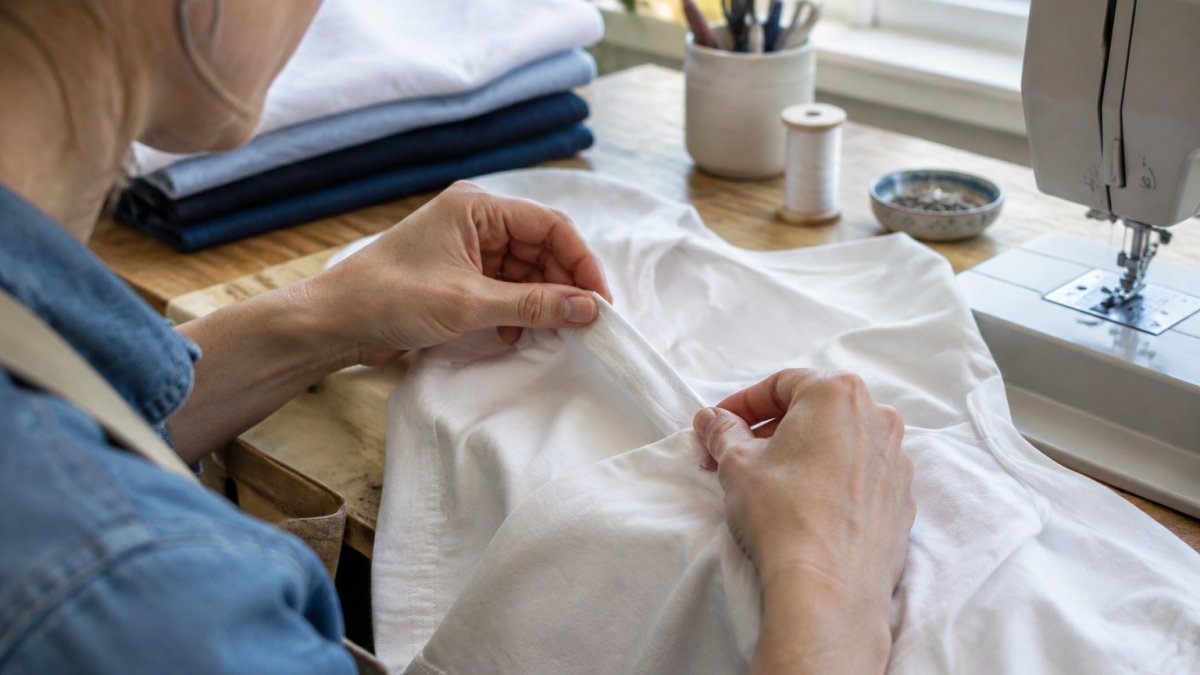
Watch out: A bright print or a trendy cut can hide weak construction on the rack. Check the stitching before you check the graphic.
Construction details that signal durability
When you inspect a shirt, a few details tell you more than the label:
- Double-needle stitching on the hem and sleeves resists unraveling.
- Reinforced neck seams hold their shape after repeated pulling over the head.
- Heavier fabric weights resist thinning and pilling.
- Pre-shrinking keeps the fit close to what you bought.
Our tees use 6.1 oz ring-spun cotton, pre-shrunk and garment-dyed, so the color settles in before you ever wear it. Garment dyeing gives a worn-in look from day one, which means less fading surprise later.
Care, repair and real garment lifespan
A shirt's lifespan depends as much on how you wash it as on how it was made. Cold water, low heat drying and no bleach protect fibers and print. Turning garments inside out before washing helps too.
Small repairs add years. A loose button, a split seam or a worn cuff can usually be fixed with basic sewing. Catching these issues early is far cheaper than replacing the piece.
Locally Made Clothing Benefits for Buyers and Communities
Locally made clothing benefits buyers by offering better quality control and clearer accountability. It also benefits communities by keeping spending close to home.
Locally made clothing can offer a few general advantages:
- Community investment: Dollars spent with local makers tend to circulate through the local economy.
- Stronger connection: Wearing something made close to home builds a sense of place.
Rhody Life also supports public access to the shoreline through sticker sales. Our Wrack Line Tee, priced at $33.00, carries a message in support of continued public access to Rhode Island's shoreline. Choosing pieces with a purpose like this turns everyday wear into a small act of community support.

How to Verify Where and How a Garment Is Made
Verifying a garment's origin takes a few minutes of checking, but the checks only work if you know what you are looking at. Most vague origin claims survive because shoppers stop at the label instead of reading the label, the product page and the garment itself as three separate sources of evidence.
Read the label like a document
Apparel labeling rules in the United States cover country of origin, fiber content and care instructions (the FTC). Those give you three useful data points before you ever touch the fabric:
- Country of origin. "Made in USA" has a specific legal meaning: the garment must be "all or virtually all" made in the United States. A label that says "Designed in USA" or "Assembled in USA" is making a different, weaker claim. Look for the exact wording.
- Fiber content. A percentage breakdown (for example, 100% cotton versus a 60/40 blend) tells you what will happen after repeated washing. Blends are not automatically worse, but a seller who lists exact percentages is showing you the spec sheet.
- Care instructions. Specific temperatures and drying guidance suggest the maker expects the garment to last. A single "machine wash" with no detail is a small signal of low engagement with the product.
Watch out: a hangtag is not a label. Marketing copy on a removable tag can say anything; the permanently attached label is the one governed by disclosure rules.
Ask questions that expose the production chain
A garment passes through several stages, fiber growing, yarn spinning, fabric knitting or weaving, cutting, sewing, dyeing, printing and finishing. "Locally made" can mean any one of those stages happened nearby, or all of them. A few questions separate the two:
- Where was the fabric made? Many brands cut and sew locally but import the fabric. That is a legitimate model, but it is not the same as a fully local garment.
- Who sews the garment? A named factory, a small sewing shop or an in-house team is a concrete answer. "Our partners overseas" is not.
- Where is it printed or dyed? For graphic tees, printing is often the stage that gets outsourced first.
- Can you see the production process? Photos or video from the shop floor are hard to fake and easy to verify against the product itself.
- What happens if a seam fails? A repair or replacement policy signals the maker expects the garment to be worn, not just sold.
A reputable brand answers these directly. If the response is a paragraph of brand-story language with no place names, treat the origin claim as unverified.
Inspect the garment as physical evidence
The final check is the piece in your hands. Even, tight stitching at the hem and sleeve, a cleanly finished neck seam and a fabric that feels substantial relative to its price all corroborate what the label and the seller told you.
These checks will not prove everything, but together they filter out most weak options quickly, and they give you a short, specific list of questions to ask before you spend money.
Cost Per Wear: Comparing Local Heritage Pieces to Fast Fashion
Cost per wear is a simple way to compare a $33.00 tee with a $10 fast-fashion shirt: divide the price by how many times you actually wear it. The catch is that the "wears" number is an estimate, and the estimate is where the real comparison lives. A method beats a single table.
A four-step method
- Estimate wears honestly. Count how often you reach for a similar item you already own in a typical month, then multiply by the months you expect to wear it. A tee worn twice a week for two years is roughly 200 wears; a statement piece worn once a month for two years is 24.
- Add repair costs. A $6.00 button-and-seam repair at year two is part of the true cost. Divide total spend, purchase price plus expected repairs, by total wears.
- Discount the replacement cycle. Fast fashion is cheap upfront but often replaced. If a $10.00 tee lasts 15 wears, you buy about 13 of them to cover 200 wears, which is $130.00 before you count the time spent shopping.
- Compare like with like. A heavier, pre-shrunk cotton tee and a thin blend are not the same product. Compare fabric weight, stitch density and care requirements, not just the price tag.
A worked example using the method:
| Item | Price | Expected Wears | Repairs | Total Cost | Cost Per Wear |
|---|---|---|---|---|---|
| Heritage tee | $33.00 | 200 | $6.00 | $39.00 | $0.20 |
| Fast-fashion tee | $10.00 | 15 | $0.00 | $10.00 | $0.67 |
| Fast-fashion tees to cover 200 wears | $130.00 | 200 | $0.00 | $130.00 | $0.65 |
Expected Wears
The numbers depend on how well each shirt holds up, and the fast-fashion column assumes you keep replacing. A thin tee that pills and stretches after a few washes may only last 15 wears, while a heavier, pre-shrunk shirt can keep going for years. Many shoppers find the higher price pays off once they count the wears and the replacements.
The upfront-price objection
The honest counterargument is cash flow: $33.00 today is harder than $10.00 today, even if the math favors the heritage piece over two years. A practical response is to buy one better staple at a time rather than replacing a whole drawer at once, and to treat the price difference as a durability bet you can verify by inspecting fabric weight and stitching before you buy. If a locally made piece cannot show you why it costs more, heavier fabric, reinforced seams, a repair policy, the cost-per-wear case is weaker, and you should say so with your wallet.
Fast fashion is cheap upfront, but it often costs more over time through replacement. Heritage pieces ask you to buy less and buy better, and the cost-per-wear method is how you check whether a given piece earns that ask.
Building a Heritage Style Wardrobe Gradually
A heritage wardrobe grows one piece at a time. Start with the items you wear most and replace them with better versions as they wear out.
- Begin with one or two staples: A well-made tee and a hat you wear weekly.
- Add a piece when you need it: Fill gaps instead of buying in bulk.
- Choose colors you already own: Neutral and coastal tones mix easily.
- Care for what you have: Good washing habits extend every piece.
Our Bristol 250th Cap, at $31.99, is a lightweight, lived-in cap that adds local character to a casual outfit.

Start Your Own Heritage Wardrobe With Rhody Life Pieces
Heritage clothing rewards patience, careful buying and a little pride in where you live. Rhody Life makes pieces built to last and designed to celebrate Rhode Island's coast. If you want to start your own collection, begin with the Wrack Line Tee at $33.00 or the Bristol 250th Cap at $31.99, then add pieces as your wardrobe grows.
Frequently Asked Questions
What does heritage clothing mean?
Heritage clothing refers to garments built on established, traditional methods and designs that have held up over decades, often tied to a region's work, leisure or cultural history. Think sturdy cotton tees, workwear-inspired jackets and classic caps. The term describes the approach as much as the look: pieces are usually made with durable materials, simple timeless cuts and construction meant for repeated wear. Locally made heritage clothing adds the question of where and by whom the garment was produced, which is what separates a classic style from a true regional product.
Is heritage clothing made to last?
Heritage clothing is generally designed for longevity, but durability depends on the specific piece. Look for double-stitched necklines and seams, heavyweight cotton and pre-shrunk finishes, which all signal construction meant to survive frequent washing. Garment-dyed fabrics arrive softer and hold their color differently from fabric dyed after cutting. Follow the care label closely, wash cold and dry low, and most well-built pieces last years rather than a few washes. Repairing small problems early extends lifespan further.
How can you tell if clothing is locally made?
Start with the label and the brand's website, then look for specifics: named factories, production locations, or statements about printing and sewing in small runs. Vague phrases like 'designed locally' can still mean overseas production, so check whether the brand says where the garment was cut, sewn and printed. Ask the company directly if the information is missing. Clear, consistent answers are a good sign; evasive ones usually are not.
What are the benefits of buying locally made clothing?
Buying locally made clothing tends to support small businesses, skilled workers and regional production, keeping more of the purchase price inside the local economy. Small-batch production also reduces overstock and waste, since pieces are often printed to order rather than mass-produced in advance. For the buyer, locally made heritage pieces often come with clearer production transparency, better construction and a stronger connection to the place they represent.
