
Table of Contents
- What Modern Coastal Style Means for Expats
- Plan Your Build: Permits, Zoning, and Budget
- Designing for the Climate: Fluid Spatial Planning and Indoor-Outdoor Flow
- Minimalist Coastal Interior Design That Handles Humidity
- Coastal Home Decor Essentials for a Relaxed Expat Home
- Vintage Inspired Coastal Fashion Trends for Everyday Wear
- Smart Home Integration for Coastal Homes
- Frequently Asked Questions
Last Updated: September 25, 2026
What Modern Coastal Style Means for Expats
Modern coastal style for expats is a design and lifestyle approach that blends clean, minimalist lines with natural textures, light colors, and open layouts suited to seaside living. This guide from Rhody Life breaks down how to build, decorate, and live in a coastal home that actually works in a humid, salt-heavy climate.
Most guides show you pretty pictures. Few tell you what it takes to pull this off in practice.
The core idea is simple: let the view do the heavy lifting. Your home becomes a calm frame around the ocean, not a competitor to it.
That means:
- Neutral base colors (white, sand, soft gray)
- Natural materials (wood, stone, linen)
- Open layouts that connect inside and out
- Fewer objects, better quality
Get these basics right and everything else falls into place.
Plan Your Build: Permits, Zoning, and Budget
Before you pick a single tile, sort out the paperwork. Building near the coast comes with rules that inland projects never face.
Legal and Zoning Hurdles for Expats
Coastal building permits in the United States often involve extra layers: shoreline setback rules, flood zone requirements, and environmental reviews.
A common mistake is assuming your home country's rules apply. They don't.
Check with your local planning office early. Ask three questions:
- Is this property in a flood or erosion zone?
- What is the minimum setback from the water?
- Are there height or material restrictions?
Budgeting for Modern Coastal Construction
Coastal builds cost more than inland ones. Salt air, humidity, and wind demand tougher materials and better sealing. Many expats find that budgeting an extra cushion for weather-related upgrades pays off within the first few years.
Build your budget in three tiers:
- Structure: foundation, framing, roof
- Climate protection: coatings, sealants, drainage
- Finish: tile, cabinetry, fixtures
Designing for the Climate: Fluid Spatial Planning and Indoor-Outdoor Flow
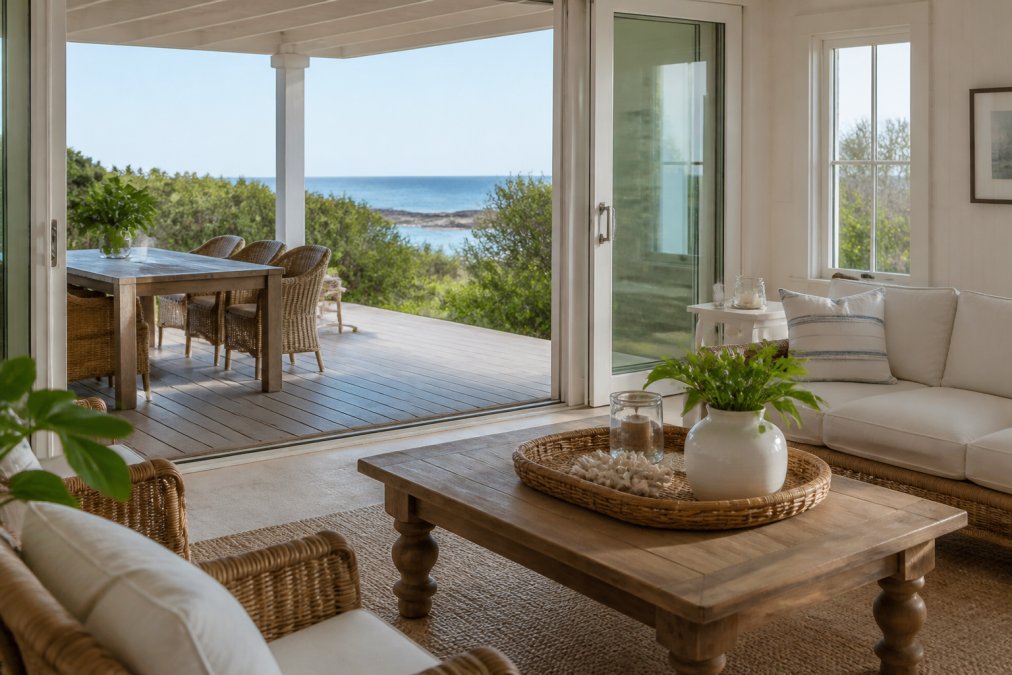
A few practical rules:
- Keep main living areas on the shaded side of the house
- Use ceiling fans to push air through open spaces
- Add deep eaves or pergolas over west-facing glass
Minimalist Coastal Interior Design That Handles Humidity
Minimalist coastal interior design works best when every material earns its place. In humid, salt-heavy air, clutter traps moisture and breeds mildew, and porous surfaces quietly absorb the damage. Simple, hard surfaces dry faster, clean easier, and hold up longer.
Rhody Local Tide Beach Sweater →
Materials That Earn Their Place
- Polished concrete, resists moisture, stays cool underfoot, and works well in entryways and kitchens. The trade-off: it needs resealing every few years, and salt tracked in from the beach can etch unsealed surfaces.
- Porcelain tile, near-zero water absorption, so it shrugs off humidity and splash. Look for a matte or textured finish; glossy tile gets slick when wet.
- Sealed natural stone (granite, quartzite), durable and cool, but requires periodic resealing. Avoid porous stones like limestone and unsealed travertine in wet rooms.
- Marine-grade or sealed hardwood, warm underfoot and forgiving of humidity swings, provided the finish is maintained. Engineered planks with a sealed core handle coastal air better than solid wood.
- Powder-coated aluminum or stainless steel, for fixtures, railings, and hardware. Standard steel rusts fast in salt air; powder coating and 316-grade stainless resist it.
Finishes That Fight Salt and Humidity
- Choose low-VOC, moisture-resistant paint with a satin or semi-gloss sheen in kitchens and baths, flat paint traps damp and shows mildew.
- Seal grout lines with an impregnating sealer; unsealed grout is the first place mold appears.
- Use marine-grade sealants around windows, doors, and any exterior penetration. Standard interior caulk fails within a season or two near the coast.
What to Avoid
- Heavy drapes that hold damp and block cross-ventilation
- Thick carpets in bathrooms, entryways, or any room with a water source
- Porous stone that stains and holds moisture
- Unsealed metal hardware that pits and rusts within a year
What Works Instead
- Linen or cotton curtains that breathe and dry quickly
- Washable, low-pile rugs in living areas
- Sealed stone or porcelain tile in wet rooms
- Powder-coated or stainless hardware throughout
The Maintenance Reality Most Guides Skip
The look is easy. The upkeep is where coastal homes separate from inland ones. A realistic maintenance rhythm looks like this:
- Every 6-12 months: inspect and touch up sealants around windows, doors, and exterior joints.
- Every 2-5 years: reseal concrete, natural stone, and wood finishes, depending on exposure.
- Annually: wash exterior glass and metal with fresh water to remove salt film before it etches.
- Seasonally: check grout lines and reapply sealer where it has worn.
Coastal Home Decor Essentials for a Relaxed Expat Home
Coastal home decor essentials are the small pieces that make a house feel settled. You don't need much. You need the right things.
A few essentials worth having:
- A soft knit layer for cool evenings by the water (Rhody Life's Rhody Local Tide Beach Sweater fits this role well, with its cotton-blend knit and relaxed coastal cut)
- A simple cap for sun protection on morning walks (the Local Tide Organic Cotton Baseball Cap is made from organic cotton with a low-profile fit)
- One good throw blanket in a neutral tone
- A small tray for keys, shells, and sunglasses
Vintage Inspired Coastal Fashion Trends for Everyday Wear
Vintage inspired coastal fashion trends bring a nostalgic edge to modern coastal style. Think soft washed cottons, faded blues, and simple silhouettes that feel lived-in from day one.


For everyday wear, stick to:
- Washed cotton tees and sweatshirts
- Linen button-downs in sand or white
- Relaxed denim in light washes
- Simple canvas or leather sandals
Smart Home Integration for Coastal Homes
Smart home systems solve a real coastal problem: monitoring and protecting a house you're not always in. Humidity sensors, leak detectors, and remote climate controls let you catch issues before they become expensive repairs, and for expats who travel or split time between locations, that early warning is the difference between a quick fix and a gut renovation.
Systems That Actually Matter on the Coast
- Humidity and temperature sensors in every room, the foundation of any coastal smart setup. Pair them with a hub that logs trends, not just current readings, so you can see whether humidity is creeping up over weeks.
- Leak detection near water heaters, under sinks, and behind washing machines, a small leak in a humid house becomes a mold problem fast. Shut-off valves that close automatically when a leak is detected are worth the upgrade.
- Smart shades and automated shutters, programmed to close during peak sun and to seal up before a storm. This protects interiors from UV fading, heat gain, and wind-driven rain.
- Remote-controlled fans and AC units, let you pre-cool or ventilate a house before you arrive, and cycle air when humidity spikes.
- Storm and power monitoring, surge protection on every smart device, plus battery backup for the hub, so your system stays online when the grid doesn't.
Choosing Hardware That Survives Salt Air
Not every smart device belongs in a coastal home. Standard consumer electronics corrode faster in salt-heavy air, especially anything mounted outdoors or near open windows.
- Look for IP-rated outdoor devices (IP65 or higher) for anything exposed to weather.
- Prefer powder-coated or stainless enclosures over bare metal.
- Choose battery or hardwired devices with sealed housings over open-circuit boards.
- Stick to one ecosystem (Matter, Zigbee, or Z-Wave) so devices talk to each other and you're not juggling five apps.
The Expat Angle: Remote Peace of Mind
For expats, the real value isn't convenience, it's oversight. A home that reports its own humidity, detects its own leaks, and closes its own shutters before a storm is a home you can leave for months without dread.
A practical starter setup:
- One hub with battery backup
- Humidity/temperature sensors in each main room
- Leak sensors at every water source
- Smart shades on west- and south-facing glass
- A single app that consolidates alerts
Frequently Asked Questions
What are the current trends in coastal home design?
Current coastal home design leans toward minimalist, airy spaces with natural wood tones, polished concrete floors, and panoramic glass walls. Expats are prioritizing fluid spatial planning that connects indoor and outdoor areas, using salt-resistant materials and cross-ventilation for thermal comfort. Shaded terraces and open-concept layouts are replacing heavy traditional beach decor, creating a contemporary coastal look that works in humid climates.
How can expats incorporate local cultural elements into a modern coastal home?
Expats can blend local craftsmanship with modern coastal style by sourcing handmade textiles, ceramics, or woodwork from regional artisans. Use these pieces as accents against a neutral, minimalist base. This approach supports the local economy, adds visual identity, and keeps your home from feeling like a generic resort. Focus on a few statement items rather than filling every corner, and let the coastal setting remain the star.
What is the difference between traditional beach decor and modern coastal style?
Traditional beach decor relies on nautical themes, shells, and bright blues, often feeling cluttered or themed. Modern coastal style is more restrained: clean lines, natural textures, a neutral palette, and an emphasis on light and airflow. It favors architectural integrity over ornaments, using materials like salt-resistant timber and stone. The result is a calm, sophisticated space that suits year-round living, not just vacations.
How do you maintain a minimalist coastal aesthetic in a tropical climate?
Maintaining a minimalist coastal aesthetic in a tropical climate starts with choosing materials that resist humidity, salt, and mold, such as teak, concrete, and marine-grade stainless steel. Keep surfaces uncluttered and use closed storage to hide everyday items. Schedule regular cleaning of salt buildup on glass and metal, and ensure cross-ventilation to prevent dampness. A few well-chosen decor pieces, like a woven rug or a local ceramic vase, can add warmth without breaking the minimalist look.