
Table of Contents
- What Defines Vintage Inspired Coastal Fashion Trends
- Best Fabrics for Coastal Living: Natural Fibers That Breathe
- How to Style Coastal Chic Without Looking Costume-y
- Minimalist Coastal Outfit Ideas for Everyday Wear
- Vintage Sourcing Guide: Where to Find Authentic Coastal Pieces
- Budget-Friendly Styling and Eco-Conscious Maintenance
- Frequently Asked Questions
Last Updated: September 11, 2026
What Defines Vintage Inspired Coastal Fashion Trends
Vintage inspired coastal fashion trends blend the relaxed, salt-air sensibility of classic seaside dressing with pieces that already feel lived-in: sun-faded cotton, soft knitwear, and accessories that look like they've logged a few summers. The look borrows from the past without dressing up like it.
This guide from Rhody Life covers what's shaping the aesthetic in 2026, how to build it without looking like you raided a costume shop, and where to find pieces that hold up, the fabrics, palette, and sourcing habits that separate a wearable wardrobe from a themed one.

Most guides get this wrong: coastal style isn't a color scheme. It's a set of materials and silhouettes that happen to work near water.
Coastal Grandmother vs. Modern Vintage Coastal
Coastal grandmother style leans polished and preppy: crisp button-downs, structured totes, inherited-money ease. Modern vintage coastal keeps the ease but swaps polish for weathered texture, worn denim over pressed chinos, a broken-in cap over a straw sunhat, rope accents over gold hardware.
The distinction matters when shopping: coastal grandmother pieces read formal in casual settings, while modern vintage coastal pieces read intentional without trying. Most people under 35 land in the second camp.
Best Fabrics for Coastal Living: Natural Fibers That Breathe
Linen and cotton are the two best fabrics for coastal living because both are natural fibers that move air and dry quickly, which matters in humid, salt-heavy air (textileexchange.org). Linen handles heat best; cotton handles everyday wear best.
Linen, Cotton, and the Case for Weathered Textures
Linen wrinkles. That's the point: the creased, rumpled surface gives coastal dressing its relaxed fit and weathered texture, which is why it's stayed in rotation for resort wear for generations.
Cotton does the heavy lifting everywhere else. Look for combed or ring-spun cotton, which feels softer and holds shape longer than carded cotton; organic cotton adds a sustainability angle without changing how it wears.

A quick comparison of the two:
| Fabric | Best For | Breathability | Care |
|---|---|---|---|
| Linen | Hot days, layering | Highest | Machine wash cold, hang dry |
| Cotton (combed/ring-spun) | Everyday tees, caps | High | Machine wash, tumble low |
| Cotton-blend knit | Cool evenings, boat days | Moderate | Machine wash cold, tumble low |
Blends have a place too: a cotton-blend knit sweater gives you cotton's breathability with enough structure to hold a shape, making it a transitional layer rather than a deep-winter piece.
How to Style Coastal Chic Without Looking Costume-y
The fastest way to look costume-y is wearing every nautical reference at once, stripes, anchors, rope belts, and a sailor collar read as a theme party. Pick one reference per outfit and let the rest stay quiet.
That's the core rule of how to style coastal chic: one signal, everything else neutral.
The One-Signal Rule in Practice
A "signal" is any element that reads as coastal on its own: a stripe, rope detail, woven texture, nautical color block, or marine motif. The rule: one signal per outfit, everything else neutral.
- Stripe shirt + plain linen trouser + plain sandal works. The stripe is the signal.
- Stripe shirt + rope belt + anchor pendant + boat shoe does not. Four signals compete.
- Plain tee + plain trouser + woven straw bag works. The texture is the signal.
A useful test: remove one piece at a time. If the outfit still reads coastal without the signal piece, you have more than one signal.
Layering for Transitional Weather
Coastal weather swings hard between morning and evening. Transitional styling solves that with layers you can shed, not commit to.
- Start with a breathable base: a relaxed cotton tee or a lightweight knit
- Add a mid-layer that works open or closed: a cotton-blend sweater, an unbuttoned linen shirt
- Finish with a cap or a woven bag for textural contrast
- Keep colors in the same family so the layers read as one outfit
A common mistake is layering heavy fabrics over light ones, a linen base under a thick wool sweater looks unbalanced. Match weights loosely.
Matching Fabric Weight to Temperature
The layering list only works if the weights are right. A rough guide most stylists use:
| Temperature range | Base layer | Mid layer | Outer layer |
|---|---|---|---|
| 75°F and up | Linen or lightweight cotton tee | None | None |
| 65-75°F | Cotton tee | Open linen shirt | None |
| 55-65°F | Cotton tee | Cotton-blend knit | Unbuttoned overshirt |
| Below 55°F | Cotton tee | Cotton-blend knit | Wool or quilted jacket |
Coastal air holds moisture, so breathability matters more than insulation. Wool traps heat and damp; a cotton-blend knit sheds moisture and dries quicker when you come off the water.
One Outfit, Three Temperatures
The real test of transitional styling is whether a single outfit survives a full day. Here's how to build one:
- Morning (cool): tee, cotton-blend knit, overshirt, trouser, cap.
- Midday (warm): shed the overshirt, tie it around your waist or carry it. The knit stays on if the breeze is up.
- Evening (cool again): overshirt back on, cap swapped for a woven hat if you want a dressier read.
The pieces don't change, only the layers do. That's the point of a transitional wardrobe: fewer items, more configurations.
Minimalist Coastal Outfit Ideas for Everyday Wear
The best minimalist coastal outfit ideas rely on three pieces and one accent, not five competing for attention: fewer items, better materials, and a palette in the sand-and-sea range.
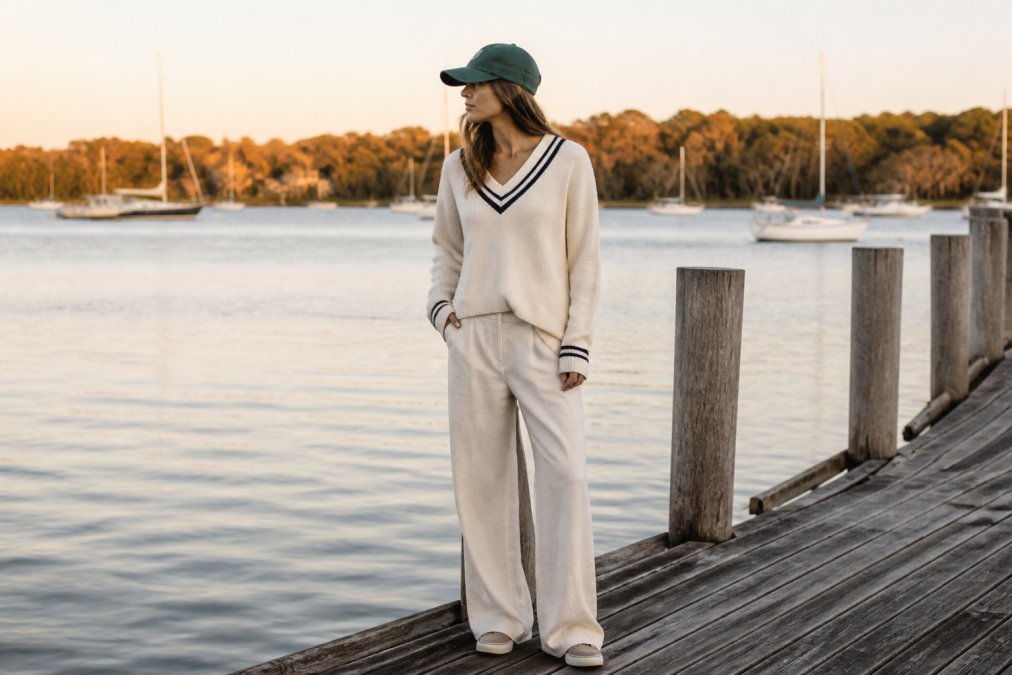
Here's a formula that works for most everyday situations:
- Base: a boxy relaxed tee in a sun-bleached neutral
- Bottom: wide-leg trousers in linen or a soft denim
- Layer: an oversized sweater or open shirt in cream or navy
- Accent: one straw or woven accessory, or a weathered cap
Notice what's missing: no marine life motifs across the front, no rope accents on every seam. Those details work as a single focal point, not a pattern.
Proportion Rules That Make the Formula Work
The formula only reads as intentional when proportions are balanced. Two rules do most of the work:
- Volume goes in one place. If the top is boxy, keep the bottom straight or tapered. If the bottom is wide-leg, keep the top closer to the body or tuck it. Two oversized pieces at once read as shapeless rather than relaxed.
- Show one narrow point. A defined ankle, a wrist, a collarbone, or a waistband gives the eye a place to rest. Roll a sleeve, cuff a trouser, or half-tuck a tee to create it.
A common pattern is sizing up on everything at once. Size up on the tee while keeping trousers true to size to preserve drape without losing the silhouette.
Styling by Body Type
Most coastal guides describe the look but skip how it lands on different frames. The principles don't change with size, but placement does:
- Rectangle and athletic builds: create a waist line with a half-tuck or a belt. A straight wide-leg trouser adds visual curve without adding bulk.
- Pear shapes: keep the top lighter in color and slightly structured at the shoulder. A boat neck or a dropped shoulder balances the hip line; skip cropped tops that stop at the widest point.
- Apple shapes: a longer open layer, an unbuttoned linen shirt or a duster-length knit, creates two vertical lines that slim the middle. High-rise wide-leg trousers with a tucked-in tee work better than low-rise.
- Tall frames: cropped knits and ankle-length trousers keep the proportions from stretching. Petite frames get the opposite advice: a monochrome column from shoulder to ankle reads taller than a cropped top over a long bottom.
Three Outfits, One Capsule
If you own the ten-piece capsule below, these three outfits cover most coastal days from May through October:
- Errands and coffee: garment-dyed tee, straight-leg soft denim, weathered cap, canvas tote.
- Boat day or beach walk: cotton-blend knit over a swim layer, wide-leg linen trouser, straw hat, sandals you can get wet.
- Seaside lunch: open linen shirt over a tucked tee, wide-leg trouser, leather sandal, one woven accessory.
Capsule Wardrobe Staples for a Sun-Bleached Palette
A coastal capsule wardrobe runs on roughly ten pieces that all work together. The palette is sandy neutrals, faded navy, cream, and washed denim, with maybe one muted seafoam or bay green for variety.
For the top of the rotation, the Rhody Life Wrack Line Tee is garment-dyed, so it arrives soft and lived-in rather than stiff, and it's cut in a relaxed unisex fit that layers under a sweater without bunching. At $33, it's the kind of base piece you reach for weekly rather than save for occasions.
For cooler mornings, the Rhody Local Tide Beach Sweater does the transitional work: a cotton-blend knit in cream with navy trim and a small embroidered wave-and-sun detail, priced at $78. It's lightweight enough for a boat ride and clean enough for a seaside lunch.

Finish with a cap. The Local Tide Organic Cotton Baseball Cap is organic cotton in a sand color with a sun-and-wave motif and coordinates stitched on the side, which keeps the nautical reference to a single, small detail. It's $35.
Vintage Sourcing Guide: Where to Find Authentic Coastal Pieces
Authentic vintage coastal pieces come from three places: estate sales near the water, regional thrift and consignment shops, and small makers who build new pieces with a vintage finish.
Estate sales are where genuinely old pieces live, and coastal towns tend to have them. The catch is sizing: older garments were cut differently, so measure rather than trust the tag, bring a tape measure and know your shoulder and chest measurements.
Thrift and consignment shops reward frequency over intensity: going weekly for a month beats one long Saturday. Ask when new stock hits the floor, and check the men's section, oversized sweaters and worn denim often land there first.
Small makers are the third route, where most people land in practice. New pieces with a distressed or garment-dyed finish give you the vintage look with current sizing and predictable care, the trade-off is paying for new construction, not an old garment's history.
"Vintage-inspired" and "vintage" are different purchases with different budgets. Decide which one you want before you start hunting.
Budget-Friendly Styling and Eco-Conscious Maintenance
Budget-friendly coastal style comes down to buying fewer, better pieces and keeping them in rotation longer. A $33 tee worn twice a week for three years costs less per wear than a cheap shirt replaced every season.
Eco-conscious maintenance follows the same logic. Cold washing, air drying, and spot cleaning instead of full washes all extend a garment's life and cut energy use at the same time (energy.gov).
Here's a simple maintenance routine:
- Wash cold, always. Heat is what breaks down cotton fibers fastest.
- Air dry knits and linen; tumble low only for tees and caps
- Spot clean caps with warm water and dish soap rather than soaking the whole hat
- Store knits folded, not hung, so shoulders don't stretch
- Repair loose seams early; a five-minute stitch beats replacing a sweater
For body type inclusivity, the principles don't change: relaxed fits flatter across a wider range of shapes than slim ones, and a boxy tee drapes the same way whether you're a size small or an XL. That's part of why the silhouette has stuck around.
Rhody Life also supports shoreline access through sticker sales, so a portion of what you spend on coastal gear goes back to the coastline itself. That's a small thing, but it's the kind of detail that makes a wardrobe feel connected to a place rather than just themed around one.
Federal Trade Commission guidance on environmental marketing claims is worth reading if you're evaluating sustainability claims from any apparel brand, including this one.
Frequently Asked Questions
What defines the vintage inspired coastal aesthetic?
It blends sun-bleached palettes, natural fibers like linen and cotton, and nautical details such as rope accents or marine life motifs. Unlike a costume, the look stays wearable: relaxed fits, weathered textures, and classic staples you can mix with modern pieces. Think effortless sophistication rather than theme-party energy. A distressed cap or a garment-dyed tee does more for the vibe than a full sailor suit.
How can I incorporate vintage coastal elements into a minimalist wardrobe?
Start with one or two vintage-inspired pieces and keep everything else clean. A cream cotton-blend sweater with navy trim pairs with plain wide-leg trousers. A washed cotton cap in a sandy neutral works with a simple tee and denim. Choose natural fibers, stick to a tight color palette of sand, cream, navy, and faded blue, and let textural contrast do the work instead of loud prints.
What are the best fabrics for coastal living?
Linen and cotton lead because they breathe and handle salt air well. Look for preshrunk cotton twill for hats, Airlume combed cotton for tees, and cotton-blend knits for lightweight sweaters. Organic cotton is a strong choice if you want fewer pesticides in the supply chain. Avoid heavy synthetics that trap heat and show wear quickly in humid, breezy conditions.
How do I style coastal chic for transitional weather?
Layer with intent. A lightweight knit sweater over a swimsuit or tee handles cool beach mornings, then comes off by noon. Add a weathered cap for sun protection and a woven bag for texture. Stick to a sun-bleached palette so layers feel cohesive, and choose relaxed fits that drape rather than cling. Transitional styling is about pieces that work from the sand to a seaside lunch without a full outfit change.
Coastal style only works when the pieces actually hold up to salt air, repeated washing, and real wear. That's the challenge: most vintage-inspired gear looks right in a photo and falls apart by August. Rhody Life builds for the opposite outcome, with garment-dyed tees, cotton-blend knitwear, and weathered caps designed to be worn hard and washed often. Browse the Rhody Life coastal collection and find pieces that carry a bit of shoreline character into everyday wear.