
Table of Contents
- How to Tell If Expensive Coastal Clothing Is Worth It
- Coastal Lifestyle Clothing for Men: What to Look For
- Durable Coastal Apparel Fabrics That Survive Salt and Sun
- How to Care for Coastal Clothing So It Lasts
- The Quality vs. Price Myth in Coastal Apparel
- Resale Value and Longevity: The Hidden Return on Investment
- Verdict: When Expensive Coastal Clothing Is Worth It (and When It Isn't)
- Frequently Asked Questions
Last Updated: September 16, 2026
How to Tell If Expensive Coastal Clothing Is Worth It
The short answer: sometimes, and the deciding factor is rarely the price tag. It's cost-per-wear. A $33 tee you wear twice a week for three years beats a $12 tee that fades by August, the entire argument for buying better coastal clothing.
Cost-Per-Wear: The Math That Changes Everything
Run the numbers before you judge a price. The Rhody Life Wrack Line Tee at $33, worn weekly for two summers (roughly 100 wears), lands at 33 cents per wear. A $15 fast-fashion tee that pills after ten washes costs $1.50 each.

| Item | Price | Realistic Wears | Cost Per Wear |
|---|---|---|---|
| Wrack Line Tee (heavyweight cotton) | $33 | 100+ | $0.33 |
| Bristol Beach Club Tee (garment-dyed) | $28 | 100+ | $0.28 |
| Typical discount tee | $15 | 10-15 | $1.00-$1.50 |
| Typical fast-fashion beach top | $20 | 8-12 | $1.67-$2.50 |
Where Your Money Actually Goes
Material and construction eat most of the cost, not the logo. A heavyweight garment-dyed tee uses more cotton per unit, and dyeing adds labor and time, the fabric is washed after construction, which is why it arrives soft rather than stiff.
Coastal Lifestyle Clothing for Men: What to Look For
Fit, fabric weight, and finish matter more than the graphic on the chest. For men building a coastal wardrobe, the priorities are a relaxed but structured cut, breathable natural fibers, and construction that survives repeated washing in salt air.
- Fabric weight of 6 oz or higher for anything worn outdoors
- Double-needle stitching at hems, shoulders, and neck
- Pre-shrunk or garment-dyed fabric so fit stays consistent
- Natural fibers or considered blends over pure synthetics for breathability
Durable Coastal Apparel Fabrics That Survive Salt and Sun
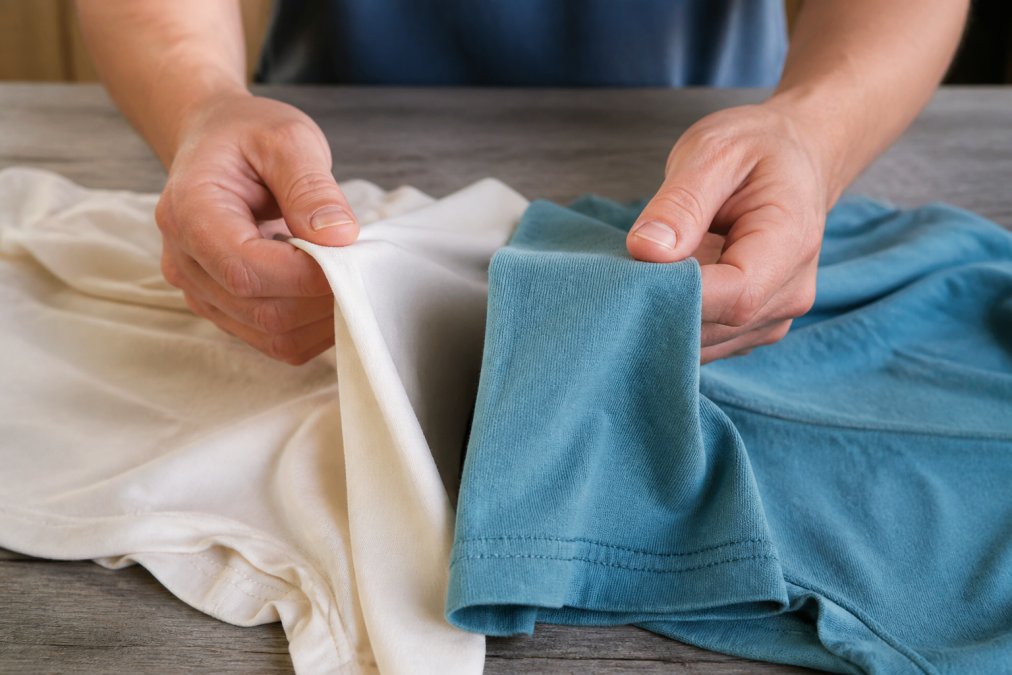
Natural fibers with real density win, and the label tells you which ones qualify. Salt air and UV break down weak fabrics faster than normal wear, so coastal clothing needs heavier natural fibers or purpose-built performance blends, and it helps to know why fabric fails faster at the shore.
Why Salt Air Ages Fabric Faster
Three things happen to cloth near the ocean that don't happen inland:
- Salt crystal abrasion. When seawater dries on fabric, microscopic salt crystals lodge in the weave, and every flex grinds them against individual fibers like slow sandpaper. Loosely spun, short-staple cotton, the kind in most $12 blanks, frays within a season; tightly spun long-staple cotton resists.
- UV degradation. UV breaks the polymer chains in natural and synthetic fibers alike. Dyed cotton fades because UV attacks the dye molecule; nylon and spandex lose stretch because UV severs their bonds. A full beach season in direct sun can equal a year of indoor wear.
- Chloride and humidity cycling. Salt is hygroscopic, it pulls moisture from the air and holds it against the fabric. That damp-dry-damp cycle accelerates mildew on natural fibers and corrosion on metal zippers, snaps, and grommets. Stainless hardware and quick-drying weaves are the difference between a jacket that lasts three summers and one that lasts one.
Which Fibers Actually Hold Up
Cotton remains the workhorse, but only the dense kind. Ring-spun and Airlume combed cottons have longer, smoother fibers that resist pilling and hold color better than carded cotton. The Bristol Beach Club Lighthouse Graphic T-Shirt uses 100% ring-spun heavyweight cotton at 6.1 oz, garment-dyed after construction, so it softens with each wash instead of degrading.

The Coastal Performance Specs Worth Paying For
Moisture-wicking is a fabric's ability to pull sweat from skin and dry quickly; breathability is how readily air passes through the weave. Performance blends win the first, looser natural weaves the second. Two more specs matter at the shore:
- UPF rating. UPF 50 blocks roughly 98% of UV radiation, a measurable, testable spec. If a brand claims sun protection without a UPF number, treat it as decoration.
- Colorfastness to salt and chlorine. Look for saltwater or chlorine testing. A dye that survives pool water usually survives ocean water; one that doesn't will bleed and fade within weeks.
Reading a Fabric Label Like a Buyer, Not a Shopper
Fiber percentage and fabric weight tell you almost everything. "100% ring-spun cotton, 6.1 oz" is a durability promise; "cotton blend" with no weight is a question mark.
How to Care for Coastal Clothing So It Lasts
Wash cold, dry low, and skip the bleach. Most coastal apparel dies from heat and harsh detergent, not salt air: cold water protects dye and fiber structure, low heat prevents shrinkage and print cracking, and no bleach means no premature fading.
A simple routine that adds years:
- Machine wash cold on a gentle cycle
- Turn graphic pieces inside out before washing
- Tumble dry low, or air dry knits and sweaters
- Never iron directly over a print
- Skip dry cleaning entirely on cotton and performance blends
The Quality vs. Price Myth in Coastal Apparel
Price correlates with quality, but it doesn't guarantee it. Plenty of mid-priced coastal brands charge for the label and cut corners on fabric, and plenty of affordable pieces are genuinely well-made. Expensive isn't automatically better; cheap isn't automatically worse.
A Five-Point Construction Audit You Can Run in the Store
Most shoppers judge a garment on the hanger. Here's a 90-second sequence that catches the failures showing up six months later:
- Seam stress test. Grip the shoulder seam on both sides and pull gently. A well-made seam stays flat and returns to shape; a weak one gapes, shows daylight through the stitch line, or ripples permanently. Repeat at the side seam under the arm.
- Stitch density check. Count stitches per inch along a hem. Single-needle at 8-10 per inch is the minimum for hard wear; double-needle or cover-stitched hems at 12+ are the standard for anything built to last. Sparse stitching is the most common cost cut on mid-priced coastal apparel.
- Fabric density test. Hold the fabric up to light. If you can read text through it, the weave is too open for salt air and repeated washing. Dense 6 oz cotton shows only a faint glow.
- Hardware and trim check. Zippers should be metal or YKK-branded; plastic zippers on a $100+ jacket are a tell. Snaps should be riveted, not sewn. Drawcords should have metal or heat-sealed aglets, not frayed cord ends.
- Label honesty check. A tag listing fiber content, fabric weight, and country of manufacture signals a maker confident in the spec. "Premium materials" and nothing else tells you the spec isn't a selling point.
Where Price Genuinely Reflects Quality
Four things reliably cost more to make and last longer:
- Heavier fabric. More cotton per unit means more raw material cost and more durability. A 6.1 oz tee uses roughly 50% more cotton than a 4 oz tee of the same cut.
- Better fiber prep. Ring-spun and combed cotton cost more than carded because the process removes short fibers and aligns long ones, that's why they pill less and hold color longer.
- Reinforced construction. Double-needle stitching, side seams instead of tubular construction, and taped neck seams add labor minutes per garment, real money at a few hundred units per run.
- Finishes that add durability. Garment-dyeing, pre-shrinking, and enzyme washing add processing steps that keep fit and color stable after 20 washes.
Where Price Is Just Markup
Three things raise the price without raising quality:
- Pure brand markup. A logo on a 4 oz blank doesn't make the blank better. Identical specs at $20 more means you're paying for the name.
- Limited-edition scarcity. Small runs cost more per unit, but scarcity pricing often exceeds the production premium. A "limited drop" tee at $60 with 4 oz fabric is a scarcity play, not a quality play.
- Marketing spend. Heavy paid acquisition gets passed to the customer, it shows up in the price, not the garment.
The One-Question Tiebreaker
When two garments have similar specs and different prices, ask: what does the extra money buy? If it's heavier fabric, better fiber, or a reinforced seam, pay it. If it's a logo, a story, or a scarcity claim, don't.
Resale Value and Longevity: The Hidden Return on Investment
Well-made coastal pieces hold value in a way fast fashion never does. A quality garment-dyed tee or knit sweater in good condition resells for a meaningful fraction of its original price; a pilled, faded fast-fashion top resells for nothing.
Verdict: When Expensive Coastal Clothing Is Worth It (and When It Isn't)
Buy the expensive version when the fabric spec justifies it and you'll wear it often. Buy cheap when it's a trend piece you'll wear a handful of times, or when the price is high for reasons unrelated to construction.
Frequently Asked Questions
Is it worth buying expensive clothing?
It depends on how often you wear it. A $78 sweater worn 50 times costs $1.56 per wear. A $20 shirt worn five times costs $4 per wear. Expensive coastal clothing is worth it when the fabric holds up, the fit stays true, and you actually reach for it. Look for heavyweight cotton, double-needle stitching, and garment-dyed finishes that age well. If a piece fits your lifestyle and gets regular use, the higher upfront cost often pays off.
What defines high-quality coastal apparel?
High-quality coastal apparel starts with fabric weight and construction. Look for heavyweight ring-spun cotton (6.1 oz or more), double-needle stitching at stress points, and side-seamed or tubular knit construction. Garment-dyed finishes signal better color retention. Details like tear-away labels, pre-shrunk fabric, and reinforced necklines also matter. These features mean the garment keeps its shape and color through repeated washing, salt air, and sun exposure.
Does price always correlate with durability in coastal clothing?
No. Price reflects brand markup, marketing, and retail margin as much as material quality. A $100 shirt can use the same blank as a $35 one. The difference is often in the print method, fit, and brand story. To judge durability, check fabric weight, stitch type, and care instructions. A heavyweight cotton tee with double-needle stitching will outlast a lighter, trend-driven piece regardless of price tag.
What fabrics should you look for in high-end coastal wear?
For coastal wear, prioritize breathable natural fibers and performance blends. Heavyweight ring-spun cotton (6.1 oz) handles salt air and repeated washing well. Cotton-blend knits offer softness with structure. Nylon-spandex blends work for active pieces needing stretch and moisture-wicking. Organic cotton twill holds shape in hats. Avoid thin, loosely woven fabrics that pill or lose shape after a few washes. Fabric density and fiber quality matter more than a brand name.
How do you care for coastal clothing to make it last?
Wash cold on a gentle cycle to protect fibers and prints. Tumble dry low or hang dry to prevent shrinkage and wear. Skip bleach and fabric softener, which break down cotton over time. Iron on low heat and avoid pressing directly on graphics. For hats, spot clean with warm water and dish soap instead of soaking. Storing pieces folded rather than hung preserves knit shapes. These habits extend garment life and protect your investment.
Deciding what's worth it comes down to one question: will you wear it enough to earn back the price? At Rhody Life, we build vintage-inspired coastal apparel for people who actually live the shoreline life, from the heavyweight Wrack Line Tee to the Local Tide cap and the East Bay mock neck. Every piece is made to be worn hard and kept for years, and our sticker sales support local shoreline access. Get started with Rhody Life and build a coastal wardrobe that earns its cost-per-wear.