
Table of Contents
- What Makes Coastal Gear Durable Enough for Both Sports
- Waterproof Hiking Apparel That Handles Salt Spray
- Best Dry Bags for Kayaking and Wet-Dry Transitions
- Coastal Hiking Safety Tips for Kayak-to-Trail Days
- Footwear and Base Layers for Wet and Dry Conditions
- Weight vs. Durability: What to Carry and What to Leave
- Gear Maintenance and Saltwater Care
- Rhody Life Picks for Coastal Hiking and Kayaking
- Frequently Asked Questions
Last Updated: September 30, 2026
What Makes Coastal Gear Durable Enough for Both Sports
Durable coastal gear for hiking kayaking has to survive two very different jobs at once. Salt spray, abrasive granite, wet sand, and constant sun exposure break down ordinary outdoor clothing fast. This guide from Rhody Life walks through what actually holds up, section by section.

Coastal gear is outdoor apparel and equipment built to handle saltwater, wind, sun, and rocky terrain in the same day.
Waterproof Hiking Apparel That Handles Salt Spray
Waterproof hiking apparel for coastal use needs two things working together: a durable water repellent finish that sheds spray, and taped seams that stop water at the stitch line.
Taped Seams and Durable Water Repellent Finishes
Taped seams are stitched seams covered with a waterproof tape that blocks water from seeping through needle holes. Durable water repellent (DWR) is a surface treatment that makes fabric bead water instead of absorbing it. Both matter more on the coast than inland, because salt residue gradually degrades untreated fabric and reduces breathability.
Layering for Wind, Spray, and Sun
A three-part layering system handles the coast better than any single jacket:
- Base layer: moisture-wicking synthetic fibers that pull sweat off skin
- Mid-layer: fleece or lightweight knit for thermal regulation when wind picks up
- Shell: water-resistant, windproof outer layer with taped seams
Best Dry Bags for Kayaking and Wet-Dry Transitions
The best dry bags for kayaking use a roll-top closure and a stated waterproof rating, not just a water-resistant label. That distinction decides whether your phone and dry layers survive a capsize.
Roll-Top Closure and Waterproof Ratings Explained
Roll-top closure means you fold the bag's mouth down three or more times and clip it shut. Each fold creates a mechanical seal that water cannot push through. Waterproof rating is measured in millimeters of hydrostatic head: the higher the number, the more water pressure the fabric resists before leaking.
Coastal Hiking Safety Tips for Kayak-to-Trail Days
Coastal hiking safety tips matter most on days that combine paddling and walking, because you carry more risk with the same pair of legs. Plan the transition, not just each sport.
- Check tide tables before you launch and before you plan a shoreline hike
- Tell someone your route and expected return time
- Carry a waterproof light and a whistle on your person, not in the boat
- Wear footwear with grip for wet rock, not just trail tread
- Watch for slippery algae on shaded rocks, which is worse than it looks
Footwear and Base Layers for Wet and Dry Conditions
Footwear and base layers decide whether a kayak-to-trail day feels comfortable or miserable. Both need to handle wet-dry transitions without falling apart, and both are where most coastal kits quietly fail.
Footwear: Drainage, Grip, and the Wet-Rock Problem
Coastal footwear has to do two jobs that pull in opposite directions. Kayaking demands drainage and quick-dry uppers. Hiking demands ankle support and a lug pattern that bites into dirt and gravel. Very few shoes do both well, so the smart move is to pick based on which half of the day dominates.
For kayak-heavy days, look for:
- Drainage ports in the midsole or heel that let water exit instead of pooling
- Quick-dry uppers in synthetic mesh or neoprene, not leather (leather stays wet for hours)
- Non-marking rubber outsoles with a sticky compound, the same chemistry used in approach shoes, because wet granite and algae-covered rock are slicker than any trail
Socks: The Overlooked Layer
Cotton socks are the single worst choice for a kayak-to-trail day. Cotton holds water against the skin, loses all insulating value when wet, and creates the friction that causes blisters. Synthetic and merino blends dry faster and regulate temperature better.
Base Layers: Hydrophobic Beats Everything
Base layers should be hydrophobic and moisture-wicking. A good base layer moves sweat away from skin so the mid-layer and shell can do their jobs. If your base layer is cotton, everything above it fails, the cotton holds moisture, the mid-layer can't loft, and the shell traps damp air against your skin.
Weight vs. Durability: What to Carry and What to Leave
Weight and durability pull against each other, and the coast punishes you for guessing wrong in either direction. This is the tension most coastal guides skip, hikers optimize for grams, kayakers optimize for abrasion resistance, and a kayak-to-trail day forces you to pick a side. The right call depends on trip length, how much walking you plan, and how much abuse the shoreline will dish out.
The Core Trade-Off
Every piece of gear sits somewhere on a spectrum between light and tough. The materials that make gear durable, ripstop tarpaulin, 1000D Cordura, coated polyester, are heavier and bulkier than the materials that make gear light, silnylon, 70D ripstop, thin PU-coated fabrics. You can't have both at the same weight, so the question becomes: which failure mode can you tolerate?
A Practical Framework
| Trip Type | Priority | What to Carry | What to Leave |
|---|---|---|---|
| Short day trip, more paddling | Lightweight | 70D silnylon dry bags, packable shell, single base layer | Heavy tarpaulin bags, spare layers, camp gear |
| Full-day kayak-to-trail | Balanced | Mid-weight dry bags, abrasion-resistant shell, two base layers, spare socks | Camp stove, sleeping system, redundant tools |
| Multi-day coastal expedition | Heavy-duty | Ripstop tarpaulin dry bags, 1000D abrasion panels, full layering system, repair kit | Ultralight single-use items, anything you can't repair |
Where to Spend Weight
The smart move is to spend weight on the items that fail catastrophically and save weight on the items that fail gracefully.
Spend weight on:
- Dry bags, a failed dry bag means wet clothes, wet phone, wet sleeping bag. Ripstop tarpaulin with welded seams is worth the ounces.
- Shell layer, a shell that abrades through on coastal rock leaves you exposed to wind and spray. A slightly heavier face fabric pays for itself.
- Footwear, a blown-out sole or torn upper ends the trip. This is the wrong place to save weight.
Save weight on:
- Base layers, they fail gracefully (you get cold, not stranded). Thin synthetics are fine.
- Mid-layers, a lightweight fleece or knit does the job without bulk.
- Accessories, hats, gloves, and small items can be light without much risk.
The Repair-Kit Exception
On any trip longer than a day, a small repair kit earns its weight. A patch kit for dry bags, a length of seam tape, and a few feet of cordage weigh almost nothing and can rescue a trip when a seam peels or a strap fails. This is the one place where adding weight is almost always the right call.
Gear Maintenance and Saltwater Care
Saltwater care is the difference between gear that lasts three seasons and gear that lasts ten. Rinse everything in fresh water after every coastal outing, then air-dry it out of direct sun.
Here is a simple maintenance routine:
- Rinse shells, dry bags, and footwear in cool fresh water
- Wipe down zippers and closures with a soft brush
- Reapply DWR spray when water stops beading on shells
- Air-dry everything fully before storage
- Store dry bags unrolled and open, never sealed shut
- Check taped seams once a season for peeling
Rhody Life Picks for Coastal Hiking and Kayaking
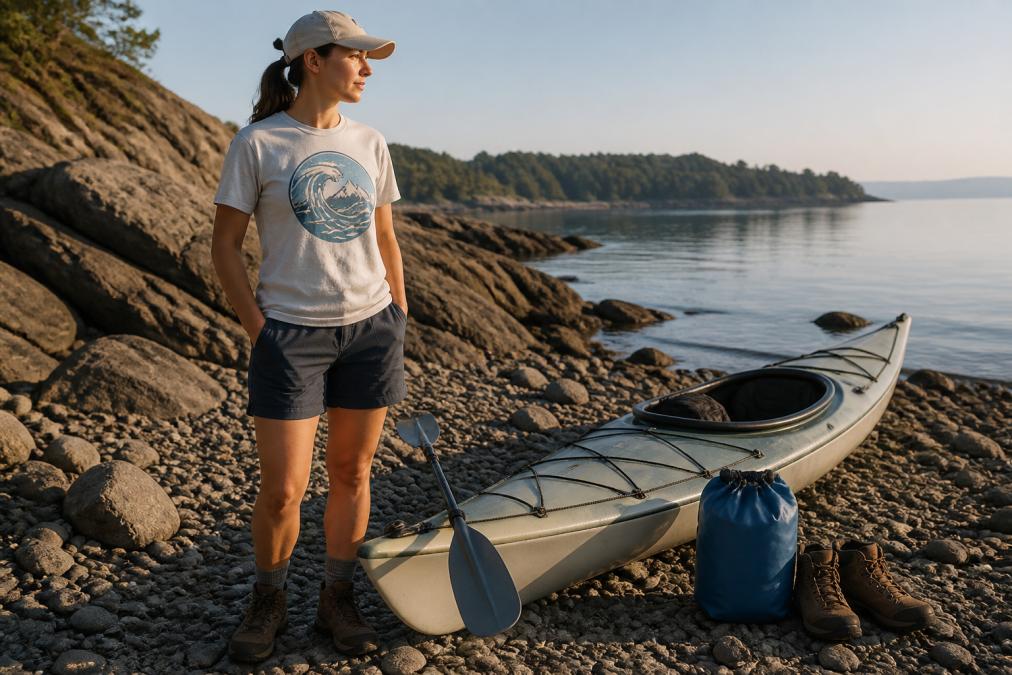
Rhody Life builds coastal apparel for people who actually spend time on the water, and a few pieces work especially well for kayak-to-trail days.
Frequently Asked Questions
What should you wear when kayaking in the ocean?
Start with a moisture-wicking base layer, add a water-resistant mid-layer, and top it with a shell that has taped seams and a durable water repellent finish. Avoid cotton next to your skin because it holds water and pulls heat away. A cap like the Rhody Surf Cap keeps sun off your face, and quick-dry footwear handles the wet-dry transition when you step onto shore.
How do you protect hiking gear from saltwater corrosion?
Rinse metal hardware, zippers, and buckles with fresh water after every coastal trip, then dry them fully before storage. Salt crystals pull moisture from the air and speed up corrosion on zipper pulls and snaps. For fabrics, follow the care label: the Rhody Life Wrack Line Tee calls for machine wash cold and tumble dry low, which keeps the garment-dyed cotton from breaking down early.
What are the essential features of a waterproof dry bag for coastal trips?
Look for a roll-top closure, a waterproof rating that matches your exposure, and welded or taped seams rather than stitched ones. A deck bag or 10 to 20 liter dry bag covers most day trips. Puncture-proof ripstop tarpaulin holds up better than thin nylon if you set the bag on rocks or drag it across a sandy launch.
What is the 120 rule for kayaking?
The 120 rule says that if the air temperature plus the water temperature is below 120 degrees Fahrenheit, you should dress for cold-water immersion rather than the air. In New England coastal waters, that applies for much of the year. It is a simple way to decide whether a drysuit or heavy neoprene is worth the bulk before you launch.
Can coastal apparel work for both kayaking and hiking?
Yes, if you pick pieces built for wet-dry transitions. Breathable synthetic layers, a water-resistant shell, and quick-dry footwear move between the two without a full change. Rhody Life pieces like the Local Tide Yoga Tank use nylon-spandex for stretch and fast drying, while the East Bay Mock Neck Sweatshirt works as a mid-layer on cooler trail days.